It’s that time of the year again: April Cools! My friend Ersei wrote a fun April Cools post two years ago, so I guess I’m joining that cult trend too.
Anyways, instead of the usual Lean propaganda, today’s post will be about brass instrument physics and 3D-printing a playable trombone!
Kublai: Whoa! I wanna hear it!
We’ll get to that soon. But first, some physics!
Brass instrument physics
Trombones are weird.
To play a wind instrument, you do some fancy stuff with your mouth which induces air pressure waves in the instrument. These waves have specific wavelengths that fit nicely inside the instrument’s tubing. For brass instruments like trombones, you vibrate your lips at some frequency like you’re blowing a raspberry, causing the air in the instrument to also vibrate loudly at a similar frequency.
The main distinction in instrument design is open tubes vs. half-open tubes, because any open end is forced by the atmosphere to be at constant pressure:
| Harmonic | Open tube | Half-open tube | Note (in major scale) |
|---|---|---|---|
| 1 |  |  | 1 |
| 2 | 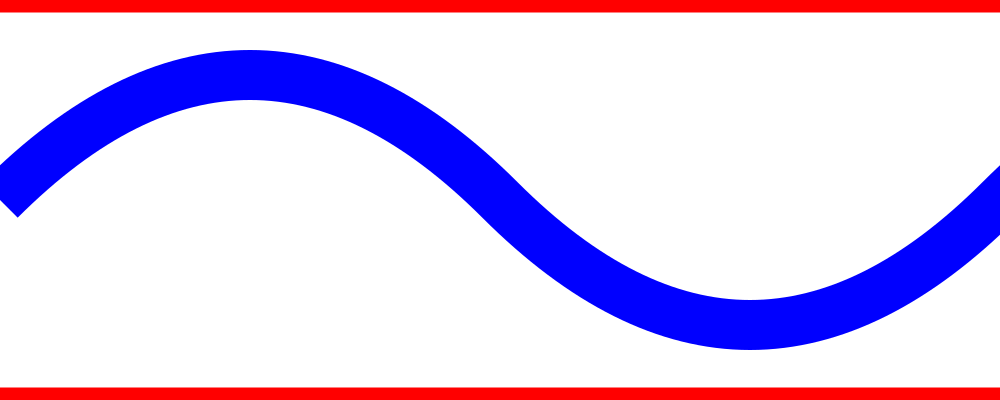 | Nonexistent | 1 |
| 3 | 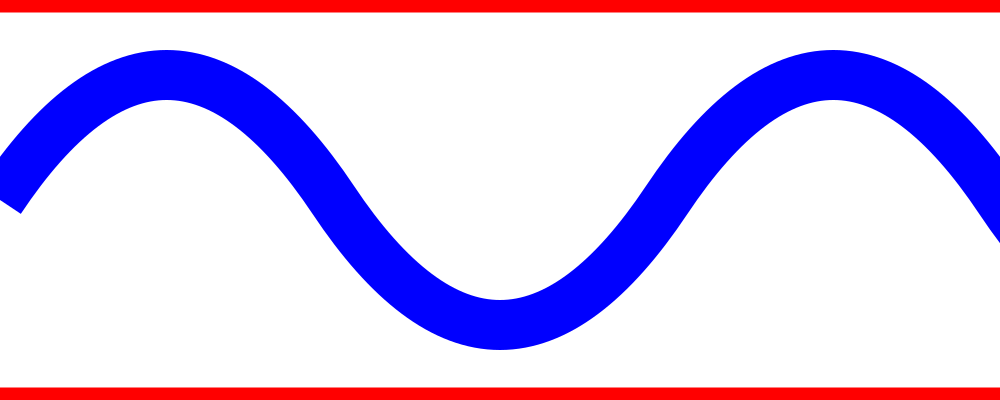 | 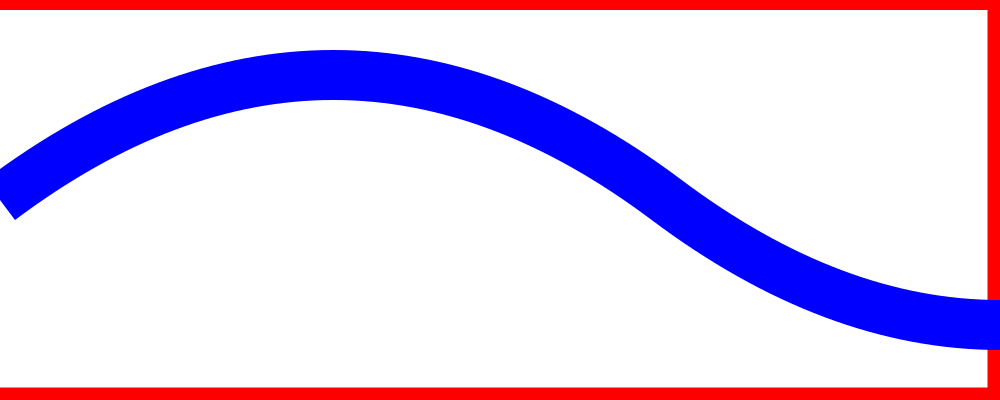 | 5 |
| 4 | 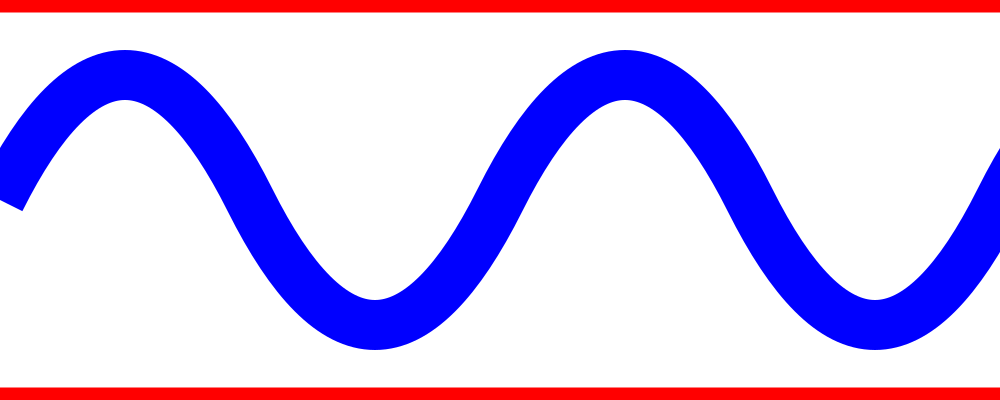 | Nonexistent | 1 |
| 5 | 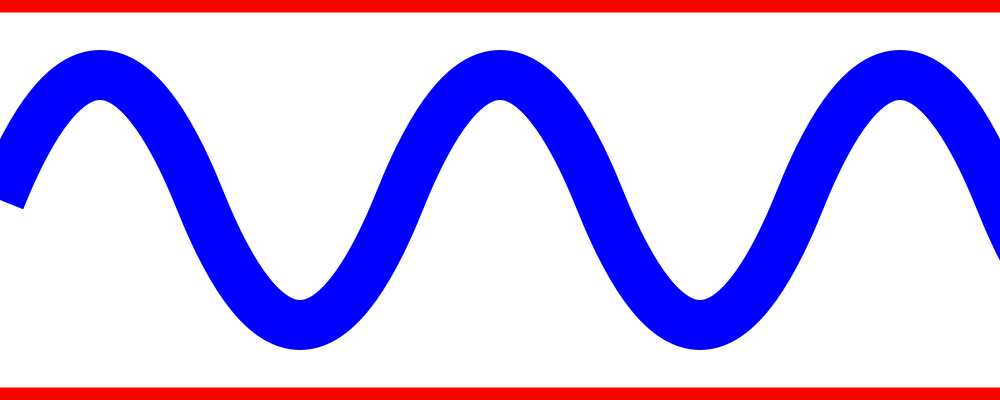 | 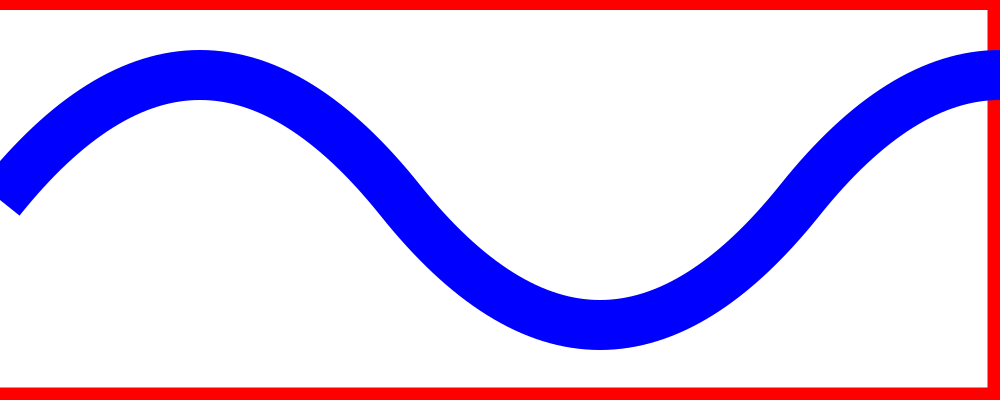 | 3 |
| 6 | 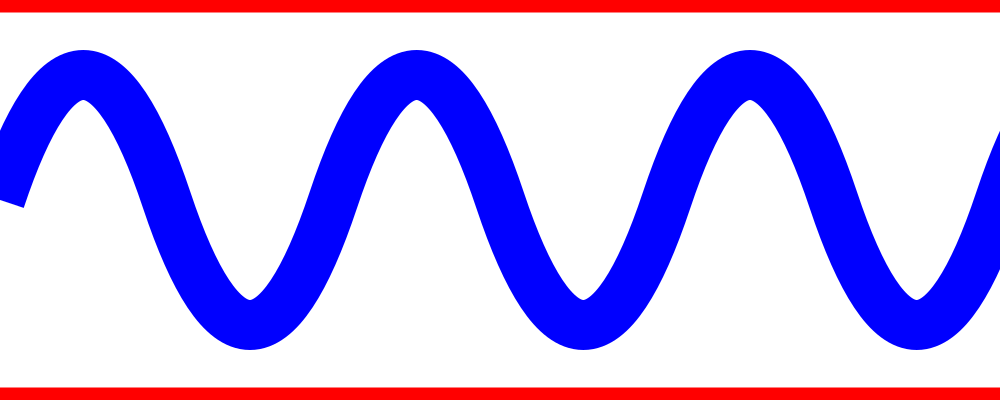 | Nonexistent | 5 |
| 7 | 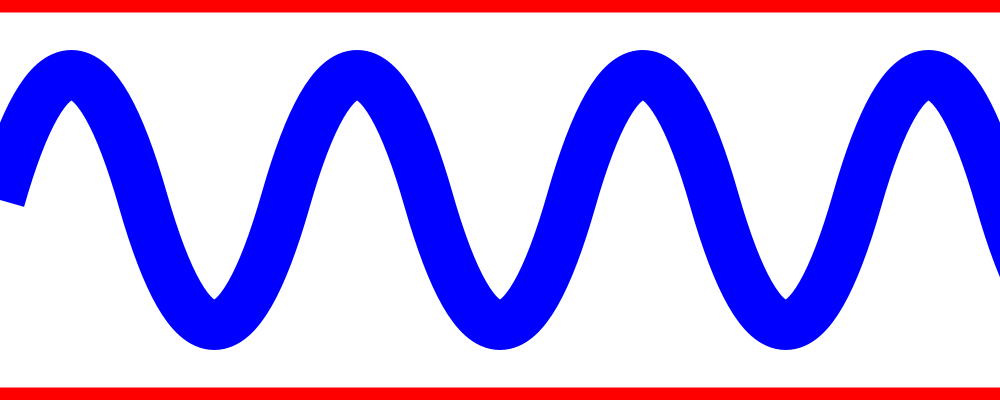 | 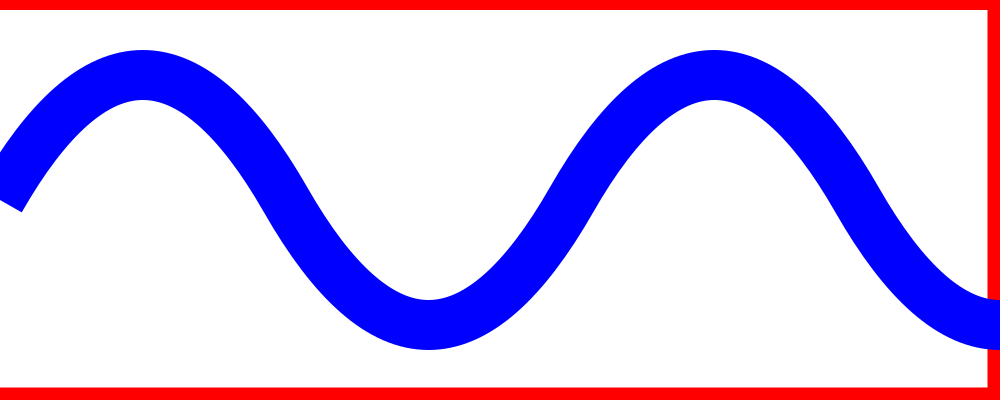 | ♭7 (out of tune) |
| 8 | 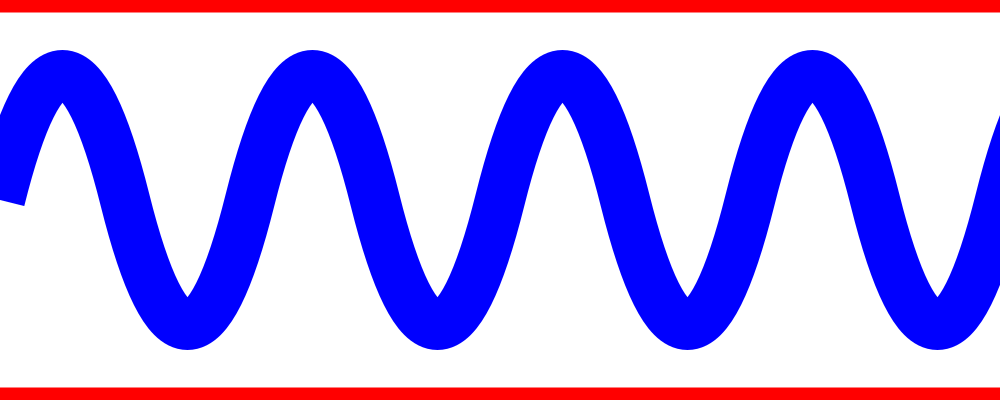 | Nonexistent | 1 |
A flute is an open tube instrument, so when you blow lightly you play the first harmonic, and when you overblow the note jumps up an 8th (an octave) to the second harmonic. In contrast, a clarinet is a half-open tube, so overblowing makes the note jump up a 12th to the third harmonic. What about trombones? Well, one end of the trombone is exposed to the atmosphere and the other end is jammed against your face. Thus, it’s a half-open tube, so it should only be able to play odd harmonics.
This is where brass instrument designers got clever, since it’s more useful for musical purposes to be able to play all integer harmonics instead of the odd ones. The physics above only work for tubes whose diameter stays constant. If we instead add a mouthpiece to one end and a flared-out bell to the other end, we can squish the harmonics together and approximate a complete harmonic series. This video has a nice demo of that trick.
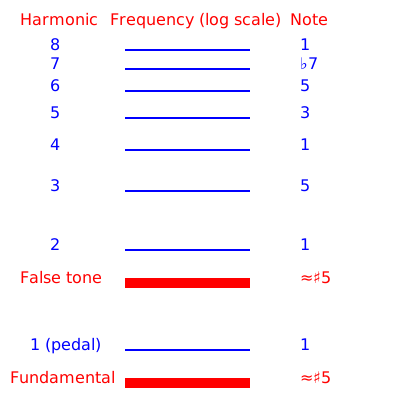
There’s one catch. Due to complicated physics reasons, this trick doesn’t lift the fundamental frequency high enough and the true fundamental frequency of the instrument lives about a third or forth below where the first harmonic should be (recall that in the diagram above, the wavelength of the 1st harmonic is twice as long in a half-open tube). Fortunately, on many brass instruments, you can still play the missing first harmonic (called a pedal tone). This is because playing a note on an instrument doesn’t just produce a pure sine wave at that frequency, but instead the whole harmonic series starting at that frequency. Thus, if you play all the harmonics above the first harmonic, you can fool your ears into hearing the first harmonic too. It’s also possible to play the note an octave below the first harmonic (called a double pedal tone) using some crazy black magic explained in this paper.
The last ingredient we need is the slide, which can extend the length of the trombone by up to √2 ≈ 1.414. Bigger tube, lower note. Easy as that. This fills in all the notes between harmonics.
Build log
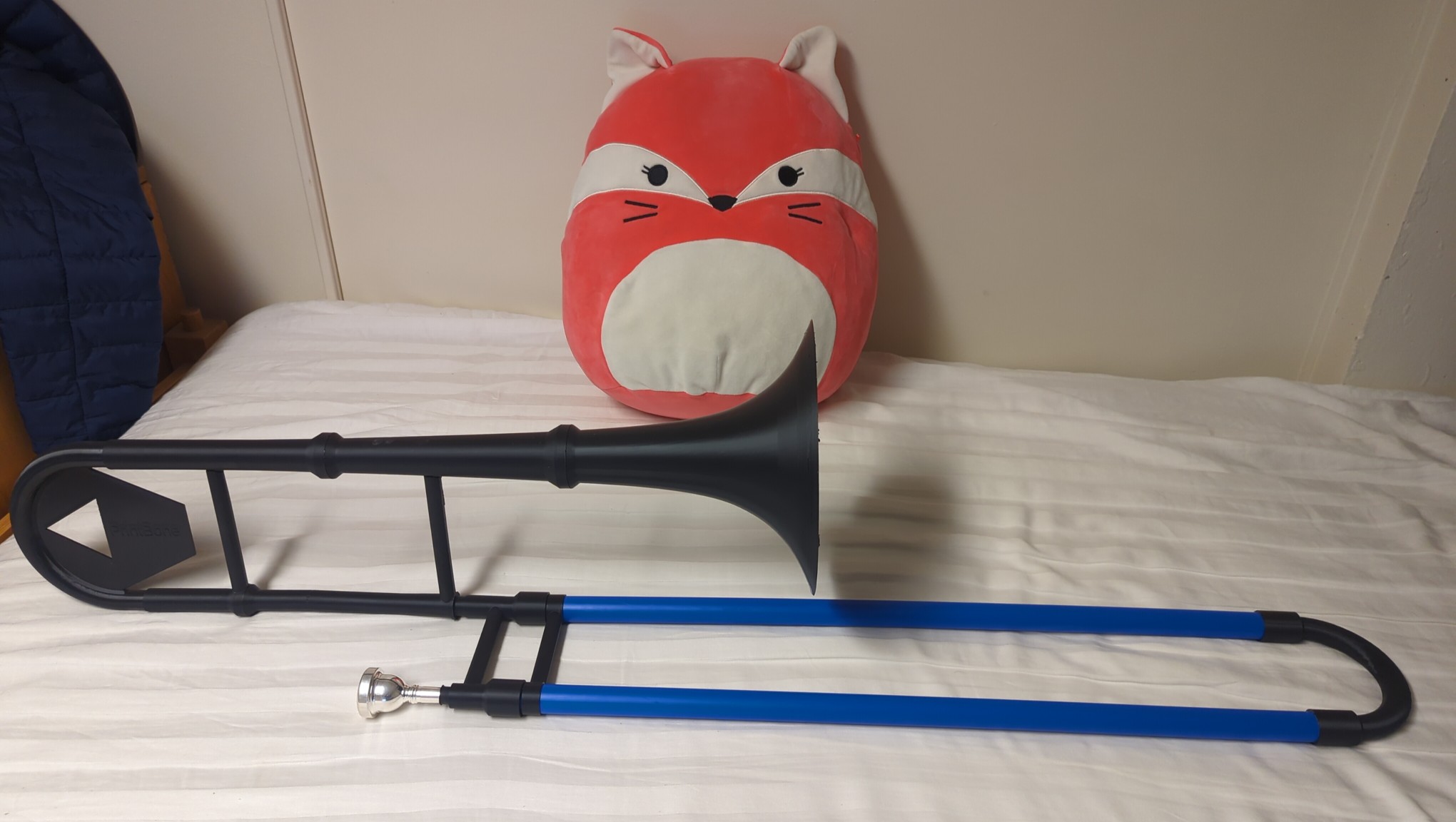
I printed the PEX PrintBone, designed by Pieter Bos and Tardigrade17014, who did the actual hard work here. I just modified a few of the files to make them more durable or easier to print.
Materials (around $30 in total):
- Two PEX pipes, which you can buy for $10 at a hardware store such as Home Depot. They have three color options, red (for hot water), blue (for cold water), and white (for people without OCD). The color doesn’t matter for this project.
- A metal trombone mouthpiece, which you can get for $12 on Amazon.
- Slide files
- Bell files
- Superglue
- Slide cream for lubricating the slide (I used trumpet valve oil which seemed to work too)
I had a lot of trouble printing the tuning slide, so what finally worked for me was printing it upside down compared to what Pieter’s instructions said. I also edited the tubes on the slide grip to be shorter. The original slide grip snapped while adjusting it due to too much friction against the slide tubes. Ignoring the misprints, it took around 16 hours in total to print.
Kublai: Cool, I want to print one too right now!
Kublai, do you even know how to play a brass instrument? If not, you’ll probably just end up with a very large plastic paperweight.
Results
It works! All the harmonics are mostly in tune, it sounds pretty similar to a metal trombone, and it’s loads of fun to play. Technical specs: it has a 0.485 inch bore and 8.5 inch bell.
I omitted one detail in the physics section above, which is that the slide only goes up to √2, but the gap between the pedal tone and second harmonic is 2. Oh no! The slide isn’t long enough to play all the notes in that gap!
The conventional solution is to add a key called an F attachment, which channels the air through some extra tubing when pressed. However, the PrintBone can also play those missing notes even without an F attachment, using what are called false tones. Some brass instruments including the PrintBone have a fake harmonic between the pedal tone and the second harmonic, located an octave above the true fundamental frequency. This harmonic is quite mushy and weak and doesn’t “slot” nicely compared the other harmonics, so the false tones don’t sound that great.
I like to say that I’m better than 99% of people at playing the trombone but worse than 99% of actual trombone players. So, I asked some trombone players to try out the PrintBone. They said it felt and played pretty similar to a metal trombone, but the weight distribution was a bit unbalanced (I guess I could fix that by taping some rocks to one end) and the slide is a bit bendy.
The PrintBone doesn’t have a slide lock or water key, so I might try adding those features in the future.
Kublai: Wait! You never answered my question! So what does it sound like?
Enjoy the show.